An engineer who renovates flats in old buildings.

This is how we build a website for a renovation contractor, step by step, on a sample business: Reut Giladi Renovation, a fictional engineer who renovates flats in old buildings. Seven chapters, from the audience to the live site.

Sample project · fictional business. The business on this page is fictional. We made it up to show how we work, so there is no client here, and no reviews or results. The steps, the decisions and the work are real: this is how it goes when we work on your business.
The home page of Reut Giladi Renovation
Reut GiladiEngineering & Renovation

We keep the old. We replace what is behind the walls.

Renovation contractor

The business and its audience

Before any colour or word: who the business is, who it talks to, and what those people need to find on the site.

A civil engineer who renovates flats in buildings from the 1930s to the 1960s, from Bauhaus to the first housing blocks. She keeps the terrazzo floor, the wooden shutters and the old doors, and replaces every pipe and wire behind them. Before any quote she runs a two-hour survey of the flat and sends a written report within a week. One crew works on one flat at a time, and a whole flat takes three to five months.

Who it's for

  • People who bought an old flat in a building from the 1930s to the 1960s and want to renovate without erasing what is beautiful in it
  • Buyers who want to know, before they sign, what is hiding in the walls and what it will cost to put right
  • People who have lived in an old flat for years, whose pipes and wiring can't cope any more
  • Families who need to know in advance how long it takes, and when they can't live at home

What they need to find on the site

  • To know who answers for what is behind the walls: one person, with a name
  • A clear first step before a quote: a survey, with a time and a price
  • Open prices, even as a range, to know whether it's in the budget at all
  • To see what was kept and what was replaced in flats like theirs, with no faked before-and-after photos
  • A plan of the months of work: water, dust, noise, and when they can sleep at home

A brainstorm on the name

First we read the market: how businesses in the field name themselves. Then three concepts, and a few names out of each. We check that no business in Israel already has the name, and go on with one.

We read the names of about twenty renovation contractors in Israel and a few firms abroad. The common way in Israel is a first name and 'Renovations': local, small and often cheap. A full name or surname with 'Building' or 'Engineering' sounds trustworthy and mid to premium. An English word in Hebrew letters is common, and words like 'Top' and 'Pro' sound cheap. Initials are the cheapest-sounding way of all. Abroad, the premium way is the family name with 'Bros.', or one strong word.

  1. Concept 1: Not taken

    Lotan Bros.: two brothers' workshop

    A joiner and a tiler, sons of a joiner, with their own workshop: every kitchen front, cupboard and door is made there, in oak. One crew per flat, and a printed week plan on the door that says when the water is off.

    • Lotan Bros. האחים לוטןA surname and 'Bros.', the premium firms' way abroad, and rare in Israel
    • Lotan Workshop סדנת לוטןThe surname and the place where everything is made
  2. Concept 2: Taken

    Reut Giladi: old buildings, kept

    A civil engineer who renovates flats in buildings from the 1930s to the 1960s. She keeps the terrazzo, the shutters and the doors, and replaces every pipe and wire behind them. A survey before the quote. Careful, respectful and exact.

    • Reut Giladi Renovation רעות גלעדי הנדסה ושיפוץA full name and the trade: in an old building you want to know who answers for what is in the walls, and the name says it is one person
    • Yashan Hadash ישן חדש'Old new': a light play on words
  3. Concept 3: Not taken

    Oak & Plaster: one contract, drawing to keys

    An interior designer and a site manager who sign one contract at one price, from the first drawing to the keys. One materials board: oak, lime plaster and brass. For buyers of new flats, with tenant changes.

    • Oak & Plaster אלון וטיחTwo materials in two words
    • Plumb Line קו ומשקולתA builder's idiom as the name

Why

Our first recommendation was Lotan Bros., but the choice fell on the old buildings: a concept no one else has, which starts with a survey rather than a rendering, and gives the site its line, 'we keep the terrazzo, we replace the pipes'. The name follows the full-name-and-trade way, which sounds trustworthy, and we checked: no business goes by it, in Hebrew or in English.

Names with a first name and 'Renovations', initials and words like 'Pro' fell before the concepts: they are how the market sounds cheap.

Inspiration

We put the field's best sites on the table, from outside Israel, and choose one whose pace and structure fit the idea. We measure it with our own tool, and build on it in our own code, photos and words.

On the table

  • UNION©Québec, CanadaA small contractor that looks like a studio: four calm parts, and the phone as the main action
  • Mosaik Design & RemodelingPortland, USA'Cost and timing' and 'living through a remodel', before the quote
  • Lamont Bros.USAOpen price ranges for every kind of job, and the process in steps
  • Neil KellyPortland, USAThe five-step process right after the opening

These sites are inspiration only, and have no connection to us or to the fictional business. Each name links to the site itself.

The inspiration we chose

UNION© Québec, Canada · unionconstruction.ca

A small contractor for kitchens, bathrooms and tiling

Black and steel grey only, one grotesk at one weight, the name huge across the screen with its © beside it, and the phone number huge at the end. A contractor that looks like a studio, not an advert. That calm suits someone who promises to keep rather than tear down, and the black and grey were already the approved logo's.

We measured UNION© with our own tool at three screen widths: the eight-column grid, the four text sizes at one weight, the huge name and phone, the hairline rows, the narrow photos and the motion. We build on the structure; we don't copy it: no line of their code, no image, typeface or word of theirs is in the site.

What we took, in words

  • An eight-column grid (three on the phone), and every part numbered: the number and a small heading in the first two columns
  • One grotesk at one weight, in four sizes only
  • The name huge across the whole screen, with the mark beside it
  • Service rows with a hairline, and a photo that appears on hover
  • The phone number huge at the end, as the main action
  • No buttons: underlined words

What we made our own

  • Hebrew first, right to left, and the site opens at night, as the approved logo does
  • The main action is a survey, not a quote: 'Book a flat survey', with the phone beside it
  • 'Kept / replaced': two lists side by side, everything kept marked with one chip of the logo's terrazzo tile
  • Seven pages instead of one: the survey, projects by the building's year, prices as ranges, living through a renovation, the team, and booking the survey
  • A true before and after only once, marked 'the same wall'. Elsewhere, the 'during' photo is marked as another flat
  • The photo a service row shows appears on keyboard focus too, not only on the mouse

The home page's skeleton, in our own drawing

Our own drawing, at the heights we measured. No screenshot of their site is published here: it's theirs.

  1. 01Theirs: Small lines on the grid, and the name huge across, with its ©Ours: What she keeps, the trade, the phone and the registration line, and 'Reut Giladi' with the terrazzo tile
  2. 02Theirs: 01 About: a statement, a narrow photo at the end, and two small paragraphsOurs: 01 Kept / replaced: the brand's line, the joiner at the window, and the two lists
  3. 03Theirs: 02 Services: four hairline rows, and a photo by the cursorOurs: 02 What we do: six rows, from the survey to a whole flat
  4. 04Theirs: 03 Work: narrow photos at two sizesOurs: 03 Projects: four flats, each by the building's year
  5. 05Theirs: 04 Contact: the phone number across the whole screenOurs: 04 Book a survey: the phone, 'Book a flat survey', the e-mail and the hours
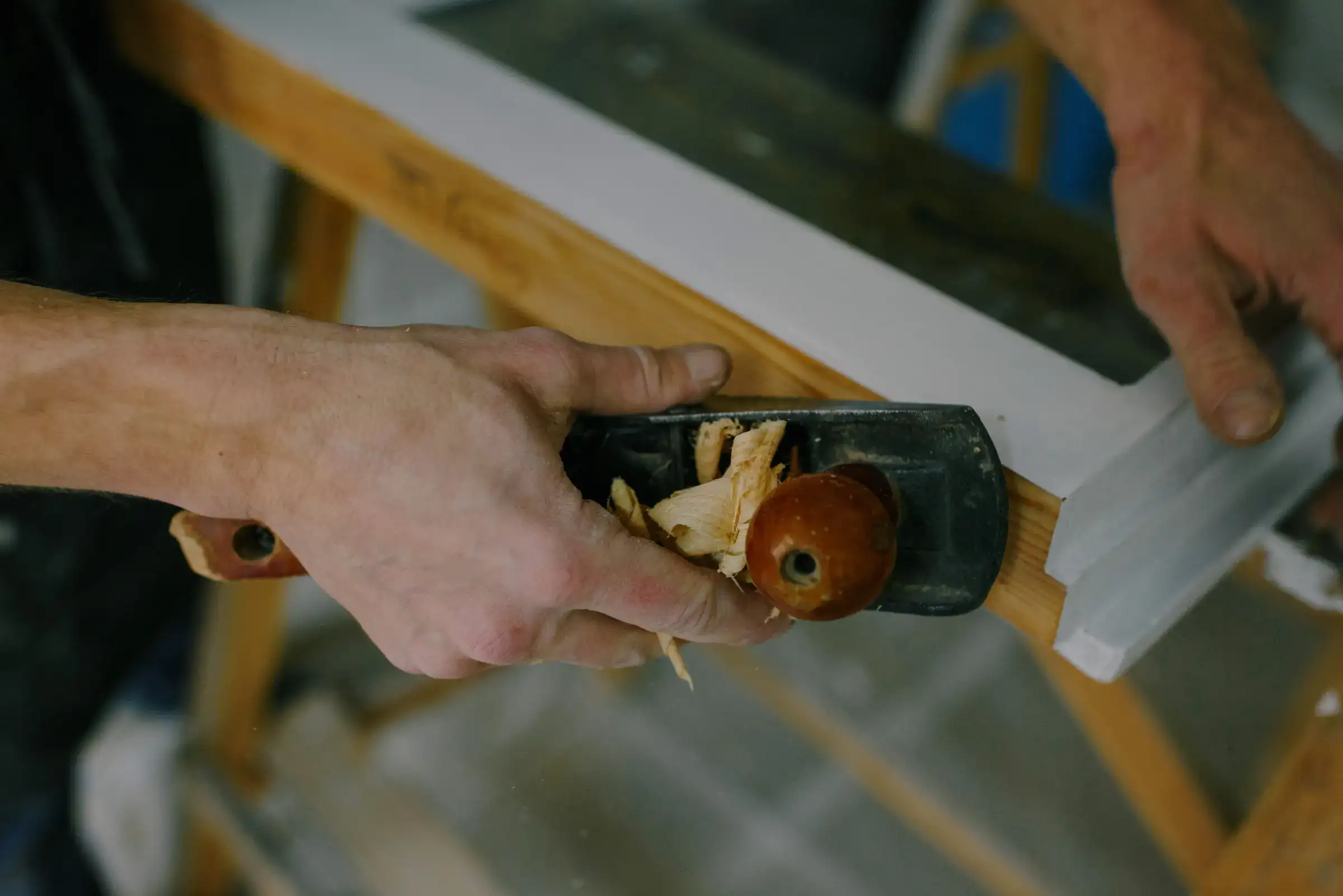
  6. 06Theirs: A wide photo, and small linesOurs: The hands planing a frame, then the credits and the legal pages

The design language

Colour, type and the logo, from the first sketch to the final one. What was turned down stays here too: it shows how we got there.

The colours

  • Steel #CBD1DBThe text at night and the ground by day13.7:1 on Ink
  • Ink #000000The ground at night, which the site opens in, and the text by day13.7:1 on Steel
  • Concrete #5B6068The tile's darker chips
  • Dust #8E949EThe tile's lighter chips, and the captions at night2:1 on Steel (large text only)6.9:1 on Ink
  • Graphite #4F535AThe captions by day5:1 with text in Steel

Two colours, as the inspiration site: black and steel grey, and nothing else. It is the only site in the set without a single touch of colour. All the colour on the site comes from the photos: wood, plaster and daylight. The tile's greys swap between day and night, so the chips keep their order of light and dark.

The type

  • את הטראצו משאירים.Heebo 400All the text, from the small captions to the huge name and phone
  • רעות גלעדיHeebo 500The name in the logo
  • 03-000-4141Heebo 400The English text and the figures

The inspiration site sets everything in one paid grotesk at one weight. Ours is Heebo, the approved logo's face: a grotesk whose Hebrew and Latin were built together, clear at caption size and when it fills the width of the screen. One weight, 400, as theirs; 500 only in the logo.

The logo, from sketch to final

  1. Day
    Night

    Round one, 14.11

    An enamel sign and a green chip

    A terrazzo tile in concrete, dust, oak and white, with one green chip, beside the name in Miriam Libre inside a rounded frame, like an enamel sign at an old building's entrance.

    The tile stayed. The colours and the frame went: beside a black-and-white inspiration site, a colourful logo stood out like a sticker. A large, plain name and a tile in greys remained.

  2. Day
    Night

    Approved, 15.11

    The terrazzo tile

    One tile with eleven chips in three greys, inside a hairline, beside 'רעות גלעדי' in Heebo with 'הנדסה ושיפוץ' under it. The tile is the favicon, it stands beside the huge name at the opening, it is the stamp on the report's cover, and one chip of it marks everything kept.

Photos

Every photo has a job: something it has to say. First we write a direction and a shot list, and only then search: one series, in one light, under an open licence.

The direction, before the search

  • The light: soft, even daylight, by a window or on an overcast site. No flash and no HDR
  • The work as craft: hands, tools and materials, close, with real dust. Never 'a builder with a thumbs-up'
  • The result as calm: finished rooms without people, that look like a real home and not a show flat
  • Before and after: never faked. A pair is the same room, or it is marked as not
  • People from behind, hands only, or small in the frame. No faces, and no readable logo on a van or a tool
  • No photo was taken in Israel

What each photo says

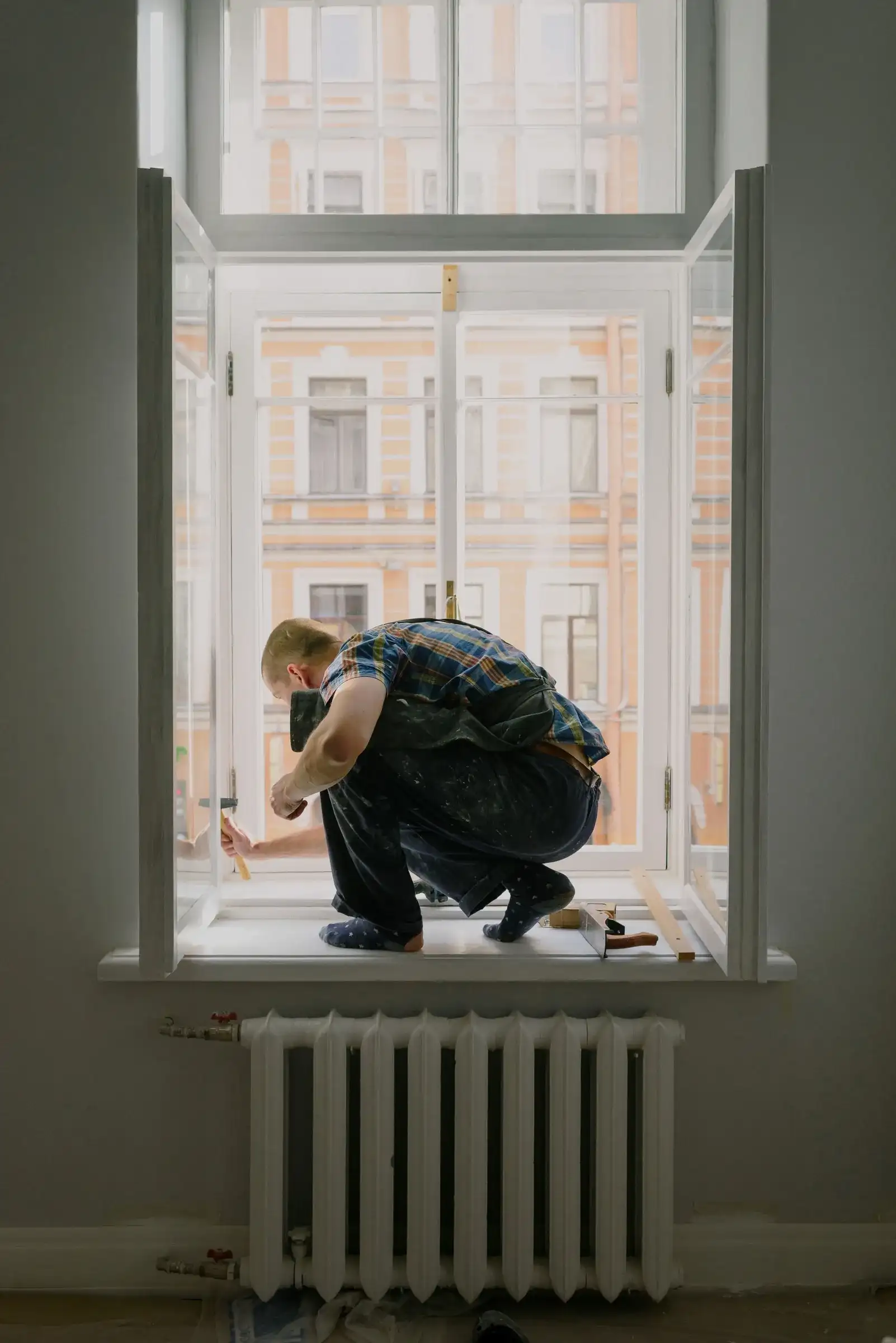
  • A workman crouched on the sill of a tall open window, in an empty room
    The opening: a workman crouched on a tall sill. Renovation as careful craft, from one shoot that carries nine photos on the site.Photo: Ksenia Chernaya · Pexels
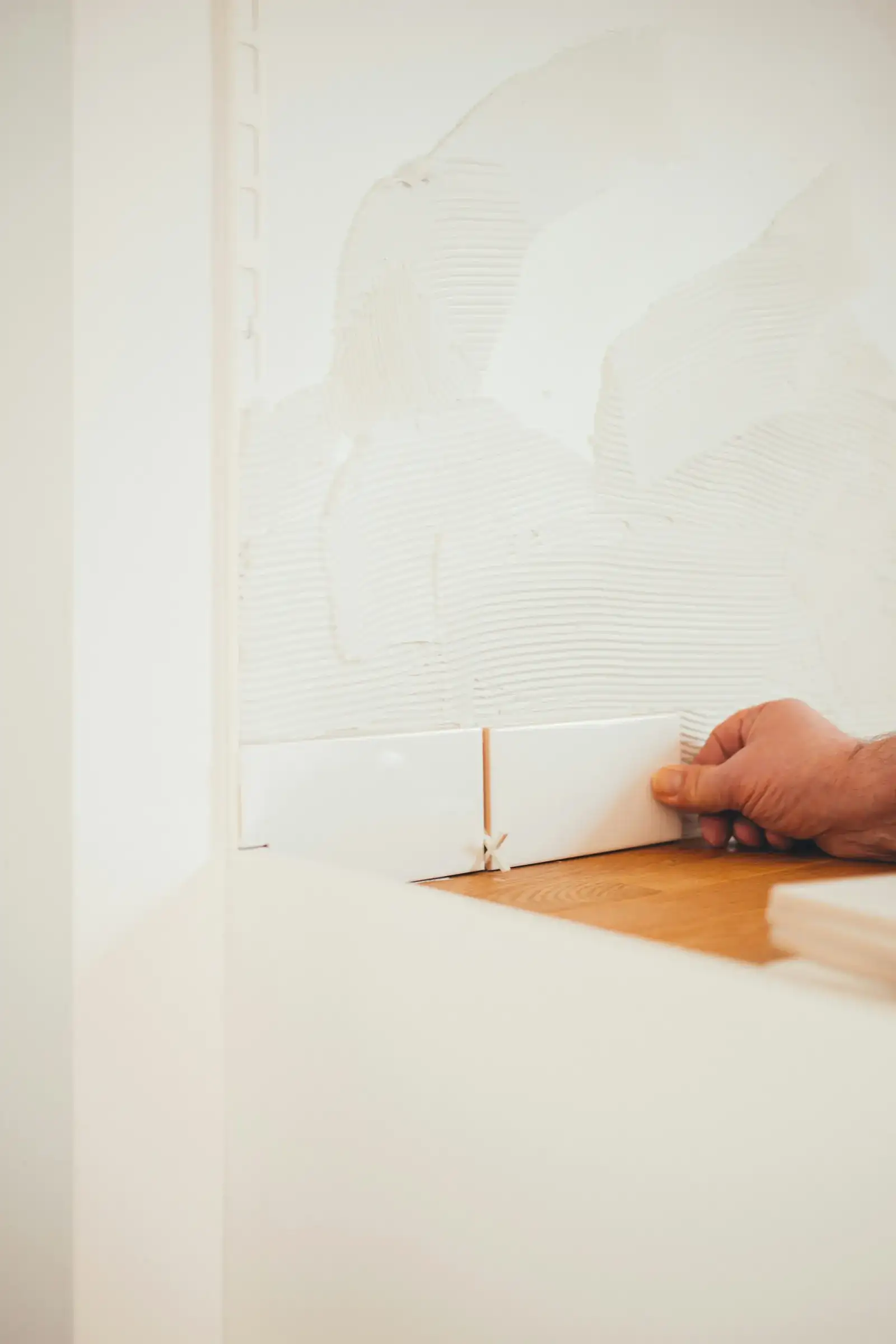
  • A hand setting the first white tile on a plastered wall above a wooden worktop
    The only true pair: the first tile on the wall...Photo: charlesdeluvio · Unsplash
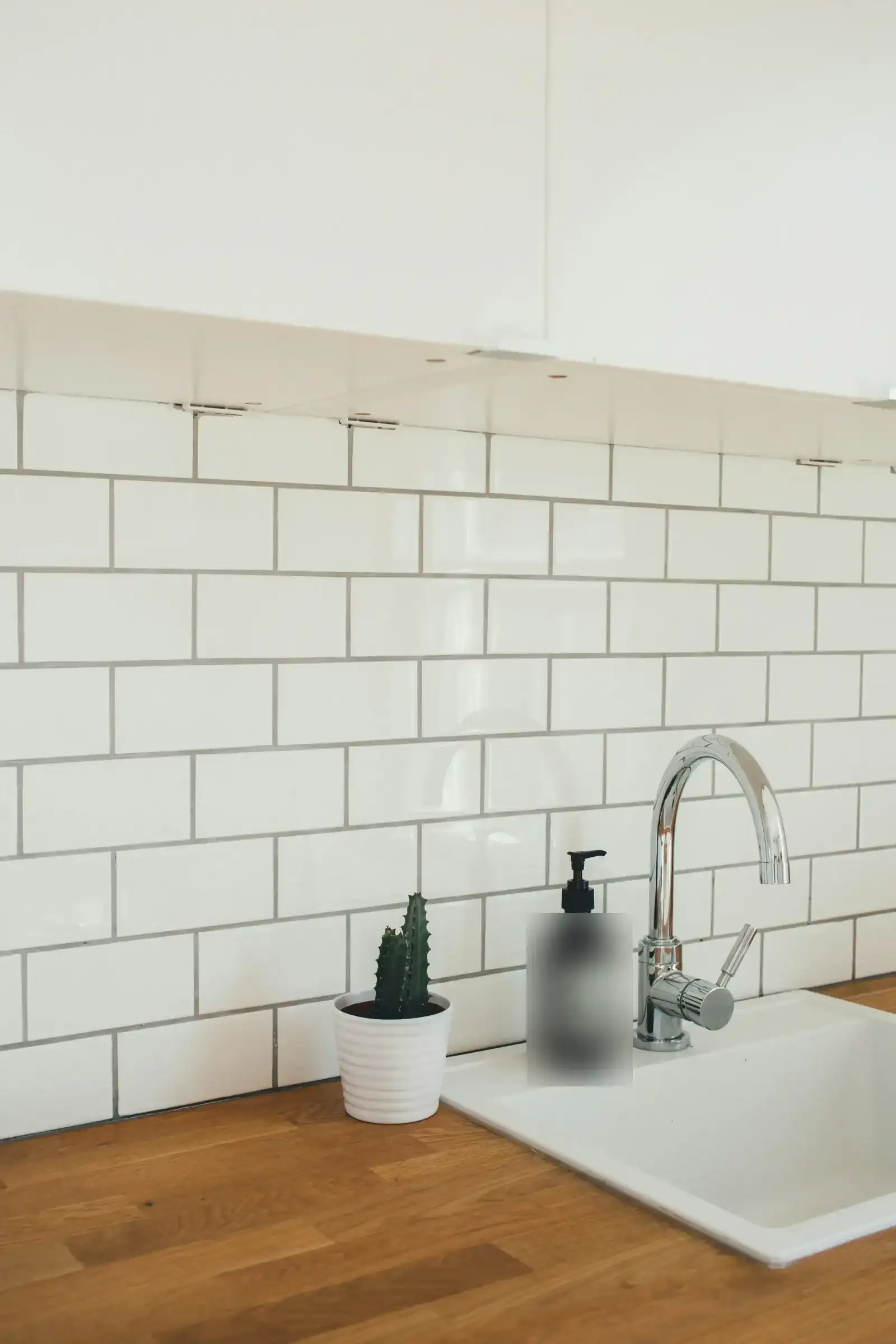
  • The same wall after: white tiles above the worktop, a sink and a tap
    ...and the same wall after. We blurred the branded bottle by the sink by script.Photo: charlesdeluvio · Unsplash
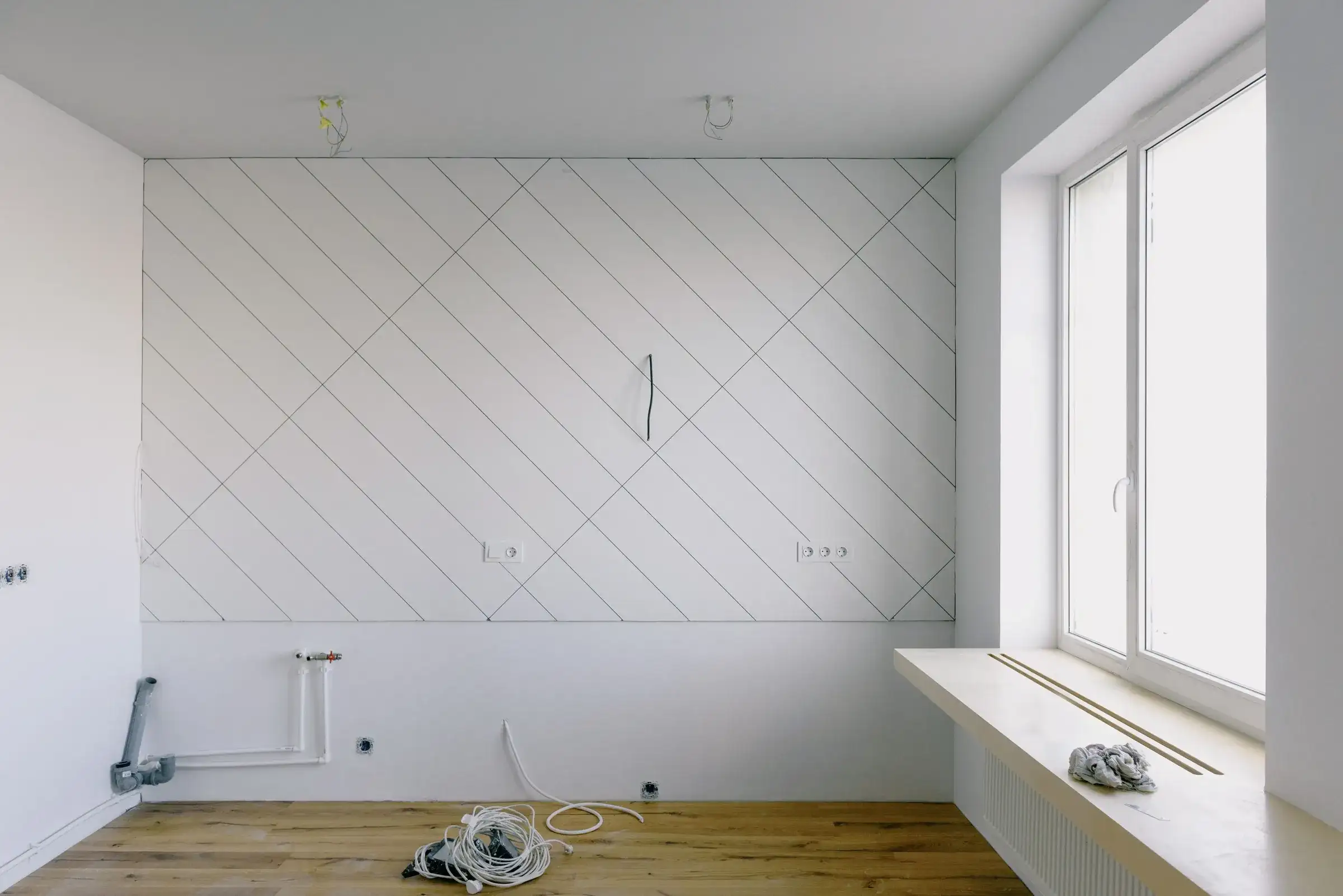
  • An empty room after the strip-out, pipes and cables coming out of the wall
    'During' from another flat: a room after strip-out, pipes and cables. On the site it is marked as such, never as the kitchen's 'before'.Photo: Ksenia Chernaya · Pexels
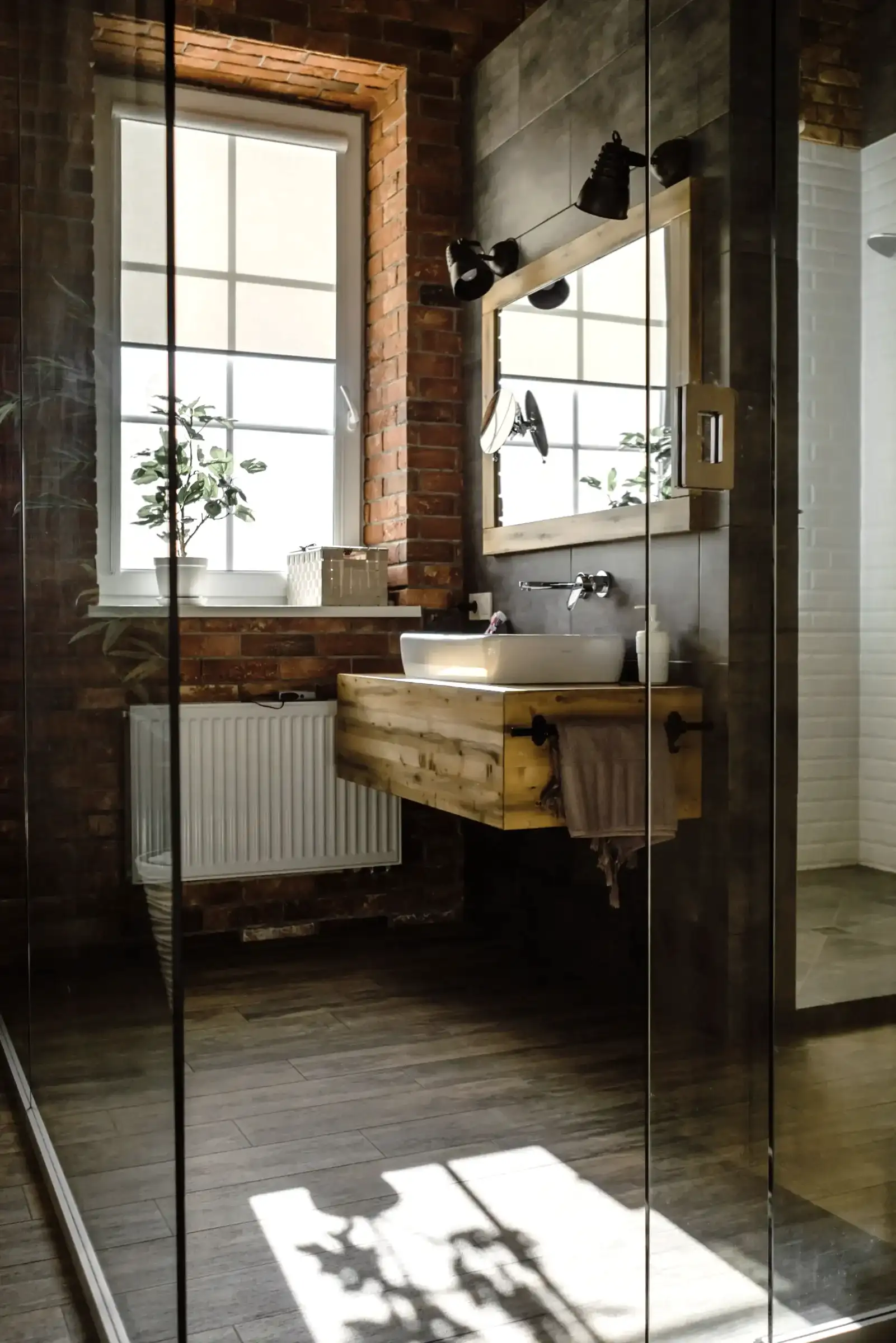
  • A bathroom with a brick wall, a wooden cabinet and a tall window
    The bathroom: the darkest in the set. We lifted it by script, brightness and saturation, so it sits with the rest.Photo: Polina Kovaleva · Pexels
  • Hands planing the edge of a wooden frame
    Hands planing a frame: the foot of every page, across the whole screen.Photo: Ksenia Chernaya · Pexels

How we chose

  • Only licences open for commercial use (Pexels, Unsplash), and every photo is logged with its photographer and the link to its page; the photographers are named at the foot of every page
  • One shoot of an old flat being renovated carries most of the site, so it all reads as one place
  • Only one true before-and-after pair was found, after searching three libraries; the rest are marked honestly
  • The van with a number plate and a maker's badge, and the real farmhouse from Ibiza, were left off the site
  • Colour is matched by a script, not by AI: a crop, a blurred brand, and a lift for the dark photos

Words

One voice for the whole brand, and a few lines that show it. The Hebrew is written first; the English is written for its own reader, never translated word for word.

The voice

Careful and exact, like an engineer who respects the building: what stays, what goes, and how long. Times and prices in figures, every price as a range, no superlatives, no reviews and no clients.

Three lines

  1. We keep the terrazzo, the shutters and the doors. We replace the pipes and the wiring behind them, all of them.את הטראצו, התריסים והדלתות משאירים. את הצנרת והחשמל שמאחוריהם מחליפים, כולם.
  2. Before any quote: a two-hour survey of the flat, and a written report within a week. What is in the walls, and what can be kept.לפני הצעת מחיר: סקר של שעתיים בדירה, ודוח כתוב בתוך שבוע. מה יש בקירות, ומה אפשר לשמור.
  3. Every price on this site is a range. The final price comes from the survey and the bill of quantities.כל מחיר באתר הוא טווח. המחיר הסופי יוצא מהסקר ומכתב הכמויות.

The site

The live site, in Hebrew and English, by day and by night, with a privacy policy, an accessibility statement and a consent box on every form.

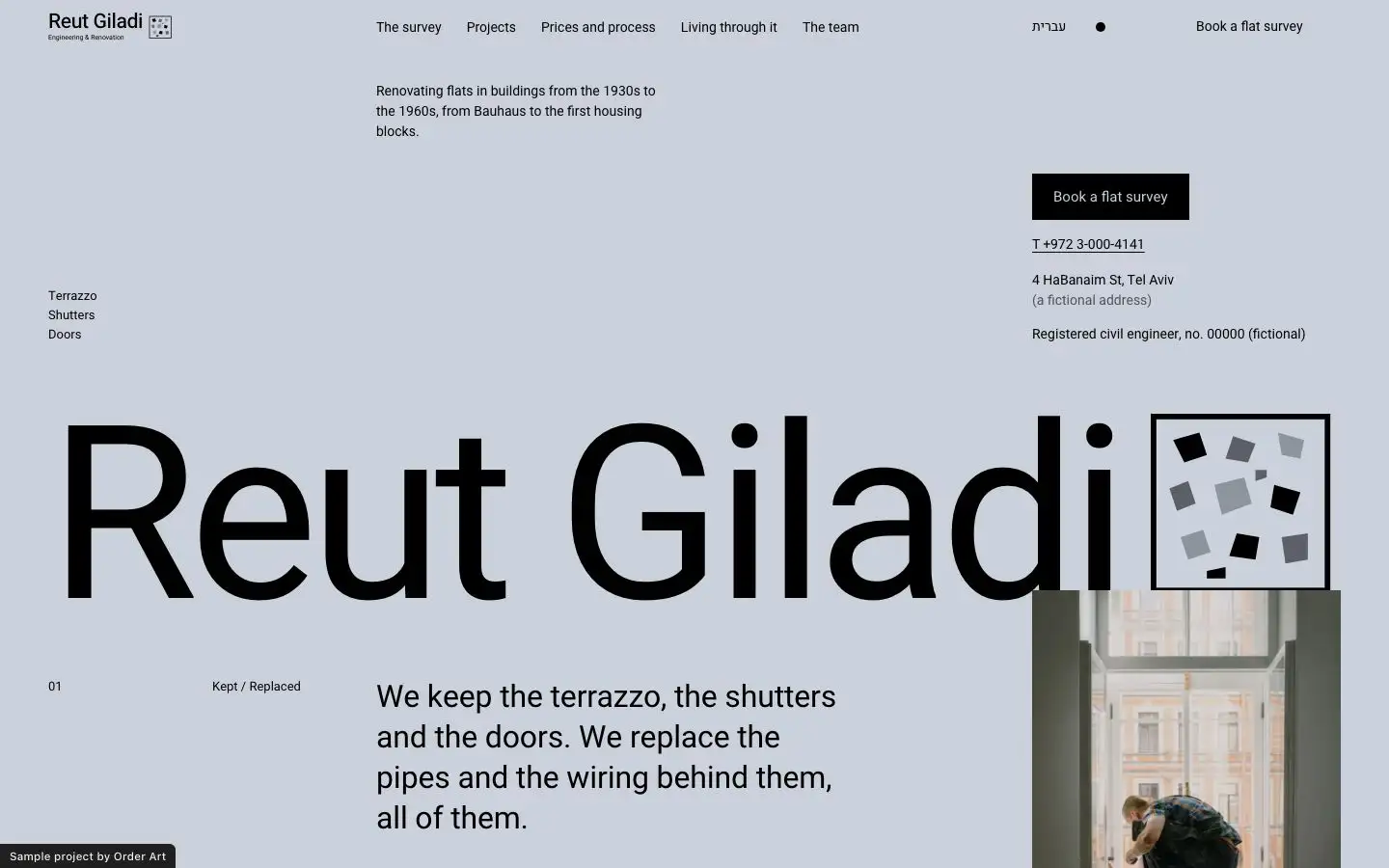
The home page of Reut Giladi Renovation in day mode
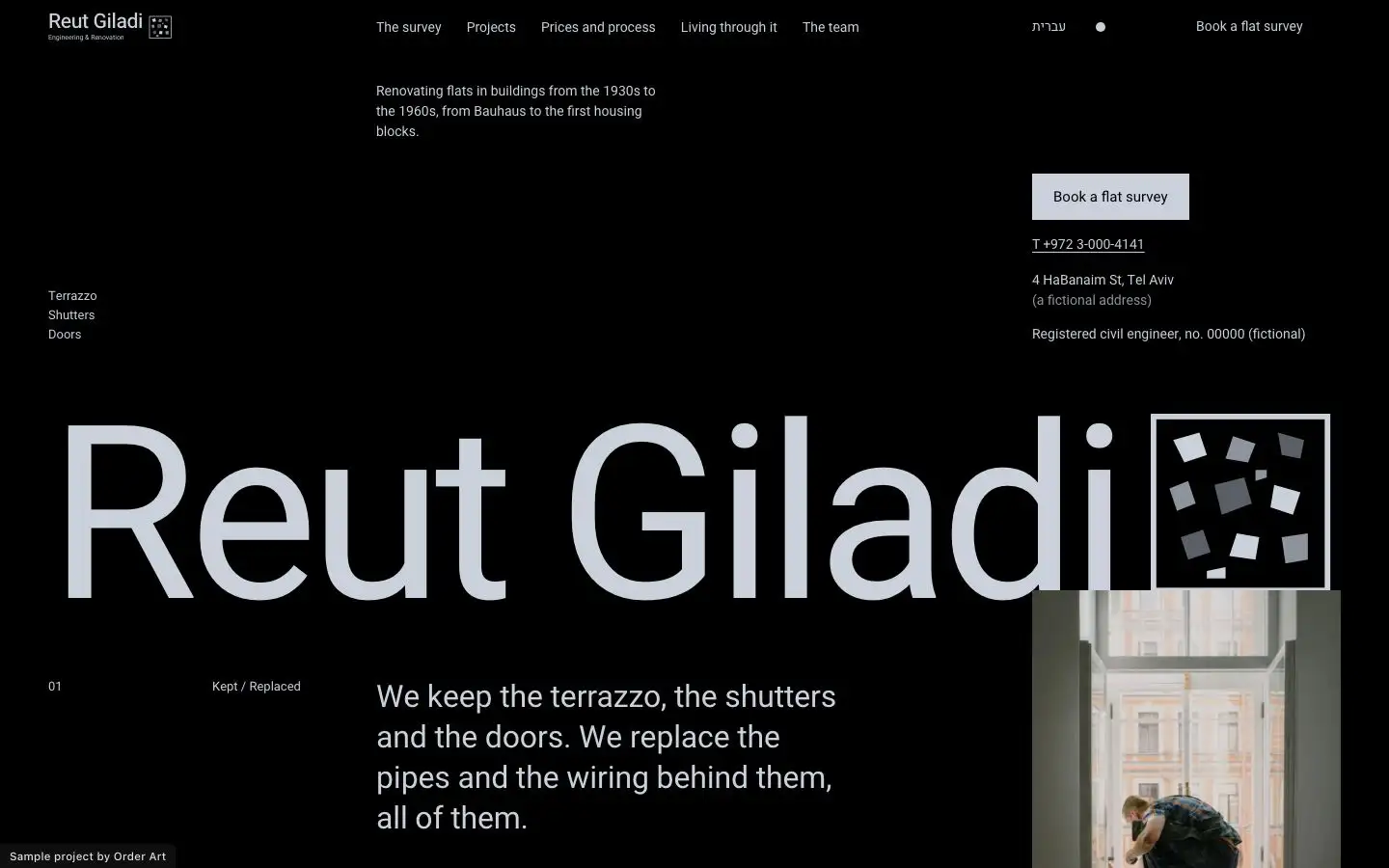
The home page of Reut Giladi Renovation in night mode
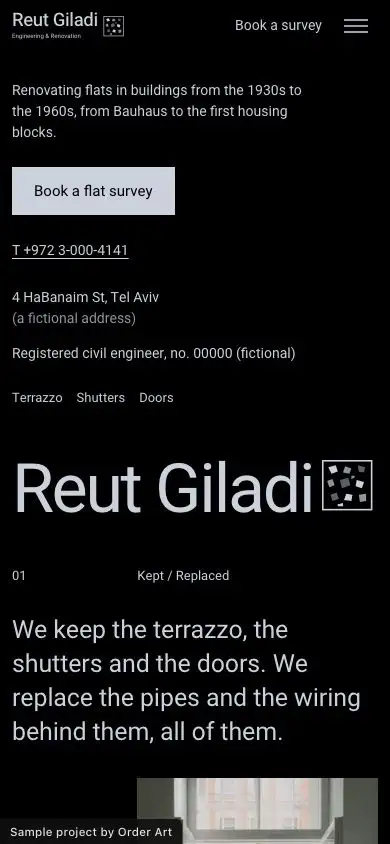
The home page of Reut Giladi Renovation on a phone
The home page, by day, by night and on a phone

The site in English: Reut Giladi RenovationThe site in HebrewThe sample site stays out of search.

The pages, in each language

  1. The survey
  2. Projects
  3. Prices and process
  4. Living through it
  5. The team
  6. Book a flat survey
  7. Privacy
  8. Accessibility

What the site has

  • Hebrew and English, night mode (the opening mode) and day mode
  • A home page on the inspiration site's grid: the name huge with the tile, 'kept / replaced', the service rows, the projects and the phone across the screen
  • The survey: what two hours check, what the report holds, and a price by the size of the flat, for buyers before they sign too
  • Four projects by the building's year, with what was kept and what was replaced, and one true before-and-after pair, marked
  • Open price ranges for every job and every size of flat, the steps, and when you pay
  • 'Living through a renovation': a month-by-month table of water, dust, noise, and when you can sleep at home
  • A form to book the survey that behaves like the real thing, then says plainly that this is a sample site and nothing was sent
  • A privacy policy, an accessibility statement to Israeli Standard 5568, and an unticked consent box on the form
  • The sample site stays out of search, so a fictional business never shows up on Google as if it were real

Want us to take your business through these seven steps?

Two fields, and we'll send you information about what interests you.

Request for informationORDER ART · Nº 0001
What interests you? (optional)

The button opens your e-mail with the message written. Nothing is stored on this site.